
The Journal 2 min read
Australian Bush Oils: Tea Tree, Niaouli, Kunzea, Rosalina and Manuka
Australia and New Zealand gave aromatherapy a whole family of fresh, antimicrobial-studied oils. Here's how tea tree, niaouli, kunzea, rosalina, manuka and lemon myrtle differ.
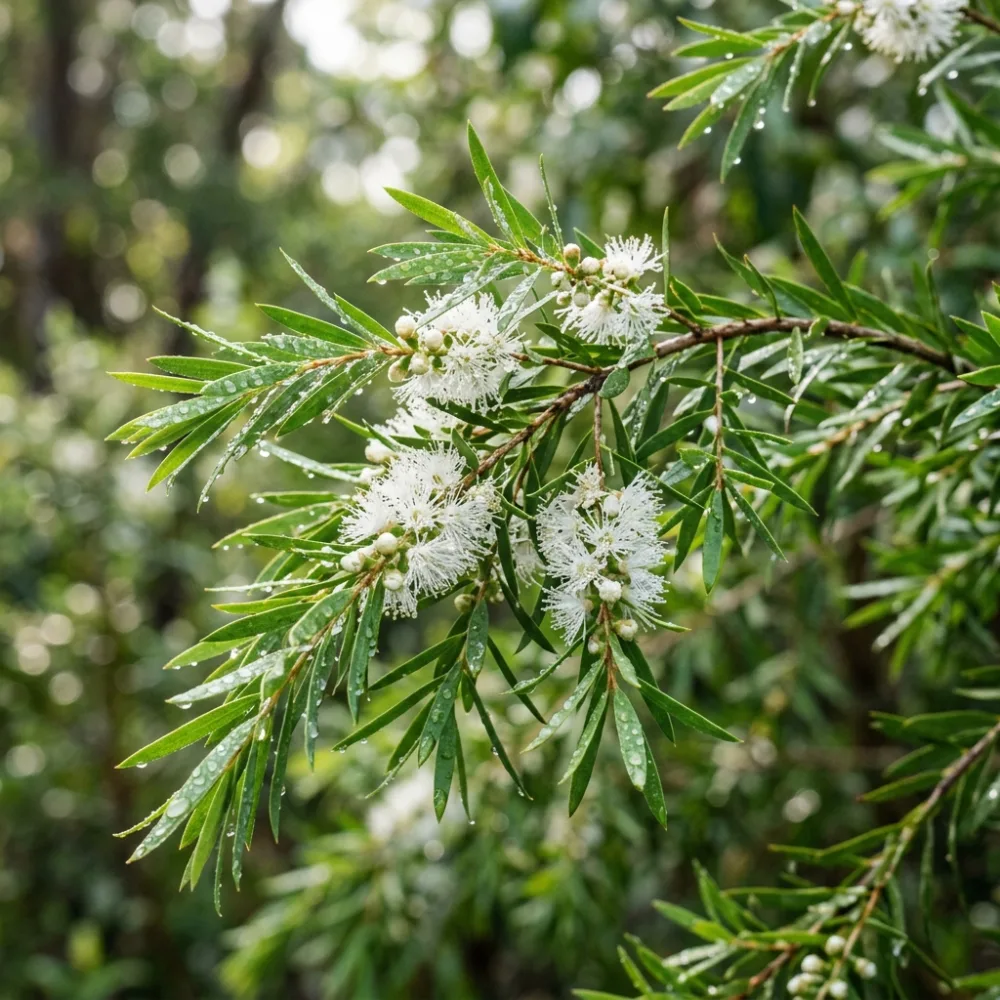
Australia and New Zealand punch far above their weight in the essential-oil world, thanks to the Myrtaceae family, tea tree and its many cousins. They share a fresh, medicinal character and a lot of laboratory antimicrobial research, but they’re chemically distinct enough to pick between. Here’s the bush-oil lineup.
The tea tree family (Melaleuca)
- Tea Tree, the famous one, defined by terpinen-4-ol (ISO-standard composition); see our tea tree and acne deep dive.
- Niaouli, a cineole-rich Melaleuca, fresher and softer than tea tree (industrial niaouli study).
- Rosalina / Australian Ericifolia, “lavender tea tree”, a linalool-led Melaleuca that’s unusually gentle (composition).
The other bush oils
- Kunzea, a Tasmanian bush oil, pinene- and cineole-rich with soothing viridiflorol (composition).
- Manuka, the New Zealand oil whose activity comes from β-triketones (leptospermone), sometimes compared with tea tree (review). Note: the oil and manuka honey are different products.
- Lemon Myrtle, the most citral-rich oil of all, intensely lemony (review); handle at low dilution (see citral oils).
- Blue Cypress, an Australian Callitris wood oil, soft and guaiazulene-blue.
Choosing between them
- Cleaning / fresh medicinal → tea tree or niaouli.
- Gentle on skin → rosalina or kunzea.
- Strong antimicrobial interest → tea tree or manuka.
- Bright lemon aroma → lemon myrtle (used sparingly).
Safety notes across the family
- Store fresh, oxidised tea tree in particular is a common allergen.
- Never ingest tea tree, and keep it away from cats and dogs.
- Dilute, even the gentle members benefit from a carrier, and lemon myrtle needs a low dilution.
Bottom line
The Australasian Myrtaceae oils give you a whole toolkit: punchy tea tree and niaouli, gentle rosalina and kunzea, potent manuka, and intense lemon myrtle. They’re related but not interchangeable, match the oil to the job and mind the freshness.
References
- Tea tree composition and ISO 4730 (2025), Phytomedicine Plus. doi:10.1016/j.phyplu.2025.100846
- Industrial niaouli (Melaleuca quinquenervia) (2008), Journal of Essential Oil Research. doi:10.1080/10412905.2008.9700007
- Geographic variation in Melaleuca ericifolia oil (2004), Journal of Essential Oil Research. doi:10.1080/10412905.2004.9698635
- Tasmanian Kunzea ambigua oil (2010), Journal of Essential Oil Research. doi:10.1080/10412905.2010.9700351
- Manuka (Leptospermum scoparium) review (2010), Phytothérapie. doi:10.1007/s10298-010-0598-x
- Lemon myrtle (Backhousia citriodora) review (2021), Foods. doi:10.3390/foods10071596
This article is educational and not medical advice.