
The Journal 2 min read
'Breathe Easy' Essential Oils: An Honest Look at the Congestion Favourites
Eucalyptus, ravintsara, myrtle, niaouli, pine and cypress are the classic 'clear the airways' oils. Here's what the cineole research actually shows, and how to use them safely.
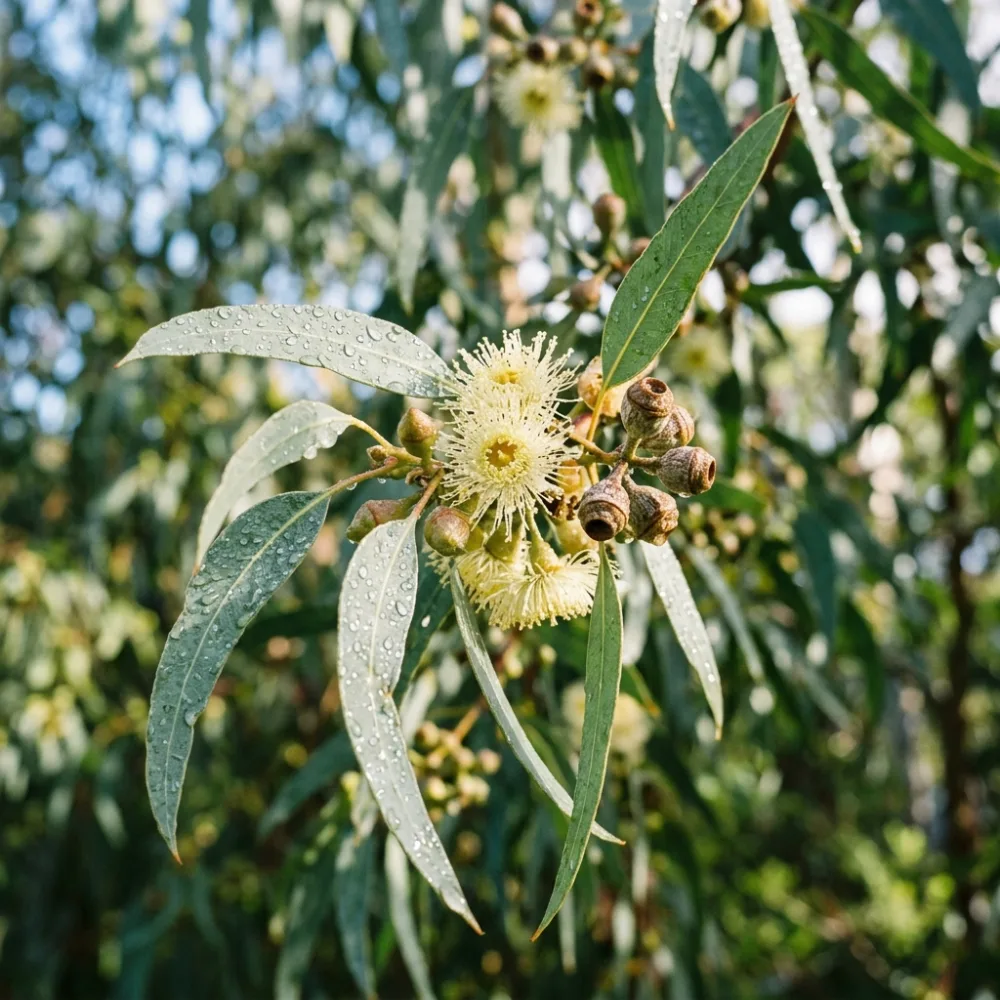
When you’re stuffy, a fresh, camphoraceous oil in a bowl of steam feels like relief, and this is one area where there’s some real science, centred on a single molecule: 1,8-cineole. Here’s an honest look at the “breathe easy” oils, what the evidence supports, and the important child-safety rule.
The molecule doing the work
Most of these oils are rich in 1,8-cineole (eucalyptol), which has been studied for respiratory symptoms, including a randomized trial in acute bronchitis where the isolated compound improved symptoms. That’s promising, but note it’s the compound in a specific condition, not proof that any diffuser blend treats a chest infection.
The cineole “breathe easy” oils
- Eucalyptus, the classic, and its species globulus (strongest), radiata (gentler), and blue (composition).
- Ravintsara, a cineole-rich Cinnamomum camphora, popular in winter blends (composition).
- Myrtle, cineole-rich but softer, a gentler alternative (composition).
- Niaouli, a fresh, cineole-rich Melaleuca (composition).
The fresh conifers and mint
Not cineole-led, but they contribute a clean, open feeling:
- Pine and Cypress, fresh, resinous conifer notes.
- Peppermint, menthol adds a cooling, “clear” sensation (but keep it away from young children’s faces).
The crucial safety rule
This is the headline caution: cineole-rich and menthol-rich oils must never be applied near the face, nose, or chest of infants and young children, where they can cause breathing problems. For kids, diffuse in a ventilated room rather than applying, and never let a child ingest these oils.
How to use them well
- Steam inhalation (a few drops in a bowl of hot water, eyes closed) or a diffuser.
- Choose gentler oils (radiata, myrtle) if the strong ones feel harsh.
- See a doctor for anything more than a passing cold, these oils make you feel clearer; they don’t treat infections.
Bottom line
The “breathe easy” oils earn their reputation from 1,8-cineole, which has genuine (if narrow) respiratory research. Eucalyptus, ravintsara, myrtle, and niaouli lead the group, just respect the firm rule about keeping them away from young children’s faces, and treat them as comfort, not cure.
References
- Fischer & Dethlefsen (2013), cineole in acute bronchitis, Cough. doi:10.1186/1745-9974-9-25
- Balacs (1997), cineole safety around children, International Journal of Aromatherapy. doi:10.1016/s0962-4562(97)80020-3
- Eucalyptus oil composition (2017), Journal of Essential Oil Bearing Plants. doi:10.1080/0972060x.2017.1304832
- Ravintsara (Cinnamomum camphora) oil (2004), Journal of Essential Oil Research. doi:10.1080/10412905.2004.9698697
- Myrtle oil composition (2000), Journal of Essential Oil Research. doi:10.1080/10412905.2000.9699481
- Niaouli composition (2008), Journal of Essential Oil Research. doi:10.1080/10412905.2008.9700007
This article is educational and not medical advice. See a healthcare professional for breathing problems or persistent respiratory symptoms.